What Tongkat Ali is
Tongkat Ali (Eurycoma longifolia), also called longjack, is a flowering shrub native to Southeast Asia. Its root has been used for centuries in Malaysian and Indonesian traditional practice, generally in the context of supporting energy, stamina and male vitality. In the last two decades it has become one of the most searched-for botanicals in the men's supplement world, which is exactly why the "1000mg" number needs unpacking.
The 1000mg question, decoded
Here is the single most important thing to understand about any Tongkat Ali product, and it is something most labels hope you will not ask: a milligram figure is meaningless without an extract ratio.
Tongkat Ali is almost always sold as a concentrated extract, described with a ratio like 100:1, 50:1 or 200:1. A 100:1 extract means one hundred kilograms of raw dried root were concentrated down to one kilogram of finished extract. So the extract is one hundred times more concentrated than the raw herb.
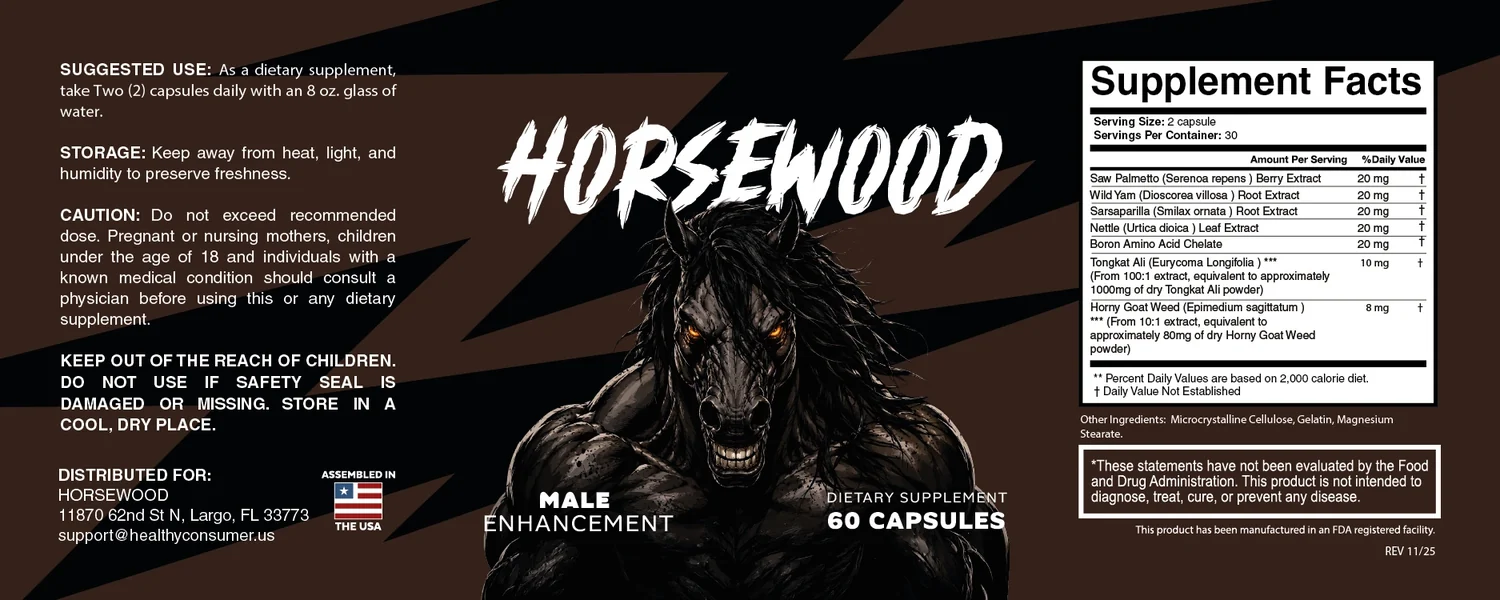
On the Horsewood label, the entry reads: 10 mg of a 100:1 extract, equivalent to approximately 1,000 mg of dry Tongkat Ali powder. Both numbers describe the same material honestly. The 10 mg is the actual weight of concentrated extract in the capsule. The 1,000 mg is what that extract represents in raw-root terms (10 mg × 100). Neither is a trick; they are two ends of the same measurement.
Where products do mislead is by printing a big "1,000 mg" on the front while burying — or omitting — the extract ratio. If you cannot find the ratio, you genuinely do not know what you are buying, because "1,000 mg of a 2:1 extract" and "1,000 mg dry-equivalent from a 100:1 extract" are wildly different products.
What the research does and doesn't show
Tongkat Ali has a real, if still-developing, research base — more than most botanicals in this category, though far from the level of a pharmaceutical. Human studies have examined it for markers related to hormonal support, stress, exercise capacity and general male wellness.
The honest summary is nuanced. Some studies report favourable changes; others are neutral. Sample sizes are frequently modest, study designs vary, and — crucially — the extracts used differ from one trial to the next, which makes it hard to generalise from one product to another. A standardised extract with a defined ratio and known marker compounds (such as eurycomanone) is a more meaningful thing to study than an unspecified powder.
What you should take from this: Tongkat Ali is a botanical with genuine traditional standing and a growing evidence base for supporting normal function — not a proven treatment for any condition. Presenting study findings as guaranteed product outcomes would misrepresent the science.
Dosing context
Because extracts differ so much, "how many milligrams" is the wrong question without the ratio attached. Much of the human research has used standardised extracts, and the dry-root equivalent is a more useful yardstick for comparison than the raw extract weight. A 100:1 extract equivalent to around 1,000 mg of dry root sits within the range that traditional use and a number of studies have worked with.
More is not automatically better. As with most botanicals, there is a sensible window rather than a "take as much as possible" logic, which is one reason not to exceed a product's recommended daily dose.
More is not automatically better. As with most botanicals, there is a sensible window rather than a "take as much as possible" logic, which is one reason not to exceed a product's recommended daily dose.
It is also worth knowing that extracts are not just about strength — they are about consistency. A standardised extract aims to deliver the same amount of marker compounds in every batch, which is why a defined ratio plus standardisation is more meaningful than a big raw-powder number. Two products both claiming "1,000 mg" can behave quite differently if one is a crude powder and the other a standardised concentrate.
Safety and interactions
Tongkat Ali is generally well tolerated in traditional use, but "natural" does not mean "risk-free," and because it acts on hormone-related pathways it deserves genuine caution.
Speak to your doctor or pharmacist before taking any Tongkat Ali product if you take hormone therapy or hormone-related medication, blood pressure medication or blood thinners, if you manage a serious medical condition, or if you have any history of a hormone-sensitive cancer. It is not for anyone under 18, and not for women, particularly during pregnancy or nursing. This is exactly the kind of decision that belongs with a clinician who knows your history.
Speak to your doctor or pharmacist before taking any Tongkat Ali product if you take hormone therapy or hormone-related medication, blood pressure medication or blood thinners, if you manage a serious medical condition, or if you have any history of a hormone-sensitive cancer. It is not for anyone under 18, and not for women, particularly during pregnancy or nursing. This is exactly the kind of decision that belongs with a clinician who knows your history.
Tongkat Ali for men over 50
Much of the interest in Tongkat Ali comes from men over 50, and the reasoning is understandable: this is the stage at which the gradual age-related decline in energy and drive becomes noticeable enough to do something about. Tongkat Ali is studied precisely for supporting healthy testosterone that is already within a normal range, which is the relevant framing for most men in this group — support for normal function, not correction of a diagnosed deficiency.
If you are over 50 and considering it, two points matter more than the marketing. First, a supplement is one input among many, and it works best alongside the fundamentals — sleep, resistance training, sensible weight, managed stress — rather than instead of them. Second, this age group is more likely to be taking daily medication for blood pressure, cholesterol or other conditions, which makes the conversation with a doctor not optional but essential. A botanical that acts on hormone pathways is exactly the sort of thing that deserves a professional's sign-off when other medicines are in play.
Before you start any supplement
Talk to your physician first if you take blood pressure medication, blood thinners or anticoagulants, hormone therapy or any hormone-related medication, if you manage a serious medical condition, or if you have any history of a hormone-sensitive cancer. Not for anyone under 18, and not for women. Nothing here is medical advice. These statements have not been evaluated by the Food and Drug Administration, and this product is not intended to diagnose, treat, cure or prevent any disease.